
Honda
FCX Clarity, a hydrogen fuel cell demonstration vehicle introduced in 2008
Hydrogen fuel does not occur naturally on Earth and thus is not an energy source; rather it is an energy carrier. It is most frequently made from methane or other
fossil fuels, but it can be produced using sources (such as wind, solar, or nuclear) that are intermittent, too diffuse or too cumbersome to directly propel vehicles. Integrated wind-to-hydrogen plants, using
electrolysis of water, are exploring technologies to deliver costs low enough, and quantities great enough, to compete with traditional energy sources.
[2]
Many companies are working to develop technologies that might efficiently exploit the potential of hydrogen energy for mobile uses. The attraction of using hydrogen as an energy currency is that, if hydrogen is prepared without using fossil fuel inputs, vehicle propulsion would not contribute to
carbon dioxide emissions. The drawbacks of hydrogen use are high capital cost, low energy content per unit volume, high tankage weights, high storage vessel pressures, the storage, transportation and filling of gaseous or
liquid hydrogen in vehicles, the large investment in infrastructure that would be required to fuel vehicles, and the low efficiency of production processes.
Vehicles[edit]
Buses,
trains,
PHB bicycles,
canal boats,
cargo bikes,
golf carts,
motorcycles,
wheelchairs,
ships,
airplanes,
submarines, and
rockets can already run on hydrogen, in various forms.
NASA used hydrogen to launch
Space Shuttles into space. A working toy model car runs on
solar power, using a
regenerative fuel cell to store energy in the form of hydrogen and
oxygen gas. It can then convert the fuel back into water to release the solar energy.
[3]
The current land speed record for a hydrogen-powered vehicle is 286.476 mph (461.038 km/h) set by
Ohio State University's
Buckeye Bullet 2, which achieved a "flying-mile" speed of 280.007 mph (450.628 km/h) at the
Bonneville Salt Flats in August 2008. For production-style vehicles, the current record for a hydrogen-powered vehicle is 333.38 km/h (207.2 mph) set by a prototype Ford Fusion Hydrogen 999 Fuel Cell Race Car at
Bonneville Salt Flats in
Wendover,
Utah in August 2007. It was accompanied by a large compressed oxygen tank to increase power.
[4]
Automobiles[edit]
Many automobile companies are currently researching the feasibility of commercially producing hydrogen cars, and some have introduced demonstration models in limited numbers (see
list of fuel cell vehicles).
[5] At the 2012
World Hydrogen Energy Conference, Daimler AG, Honda, Hyundai and Toyota all confirmed plans to produce hydrogen fuel cell vehicles for sale by 2015, with some types planned to enter the showroom in 2013.
[6] Although
Ford Motor Company and French
Renault-Nissan cancelled their hydrogen car R&D efforts in 2008 and 2009, respectively,
[7][8] they signed a 2009 letter of intent with the other manufacturers and Now GMBH in September 2009 supporting the commercial introduction of FCVs by 2015.
[9] General Motors said it had not abandoned fuel-cell technology and still plans to introduce hydrogen vehicles like the
GM HydroGen4 to retail customers by 2015. Charles Freese, GM’s executive director of global powertrain engineering, stated that the company believes that both
fuel-cell vehicles and
battery electric vehicles are needed for reduction of greenhouse gases and reliance on oil.
[10]
In 2009,
Nissan started testing a new FC vehicle in Japan.
[11] Daimler has introduced its B-class demonstration FC vehicle.
[6] In 2011,
Hyundaiintroduced its Blue
2 ("Blue Square") fuel cell electric vehicle (FCEV), and stated that it plans to have FCEVs available for sale by 2014.
[12] Honda stated in 2009 that it could start mass-producing vehicles based on its
FCX Clarity concept car by the year 2020
[13] and in 2009 stated that it saw hydrogen fuel cells as "a better long term bet than batteries and plug-in vehicles".
[14] In December 2010, however, it introduced a
BEV version of the
Honda Fit, using elements of its hydrogen engine design, stating that the "industry trend seems to be focused on the battery electric vehicle".
[15]
In 2013, Lux Research, Inc. issued a report that stated: "The dream of a hydrogen economy ... is no nearer." It concluded that "Capital cost, not hydrogen supply, will limit adoption to a mere 5.9 GW" by 2030, providing "a nearly insurmountable barrier to adoption, except in niche applications". Lux's analysis concluded that by 2030, PEM stationary market will reach $1 billion, while the vehicle market, including forklifts, will reach a total of $2 billion.
[16]
Main article:
fuel cell bus
Fuel cell buses (as opposed to hydrogen fueled buses) are being
trialed by several manufacturers in different locations. The
Fuel Cell Bus Club is a global fuel cell bus testing collaboration.
Hydrogen was first stored in roof mounted tanks, although models are now incorporating onboard tanks. Some double deck models use between floor tanks.
Bicycles[edit]
Main article:
PHB (bicycle)
Pearl Hydrogen Power Sources of
Shanghai, China, unveiled a hydrogen bicycle at the 9th China International Exhibition on Gas Technology, Equipment and Applications in 2007.
Motorcycles and scooters[edit]
ENV develops electric motorcycles powered by a hydrogen fuel cell, including the
Crosscage and
Biplane. Other manufacturers as Vectrix are working on hydrogen scooters.
[17] Finally, hydrogen fuel cell-electric hybrid scooters are being made such as the
Suzuki Burgman Fuel cell scooter.
[18] and the
FHybrid.
[19] The Burgman received "whole vehicle type" approval in the EU.
[20] The Taiwanese company APFCT conducts a live street test with 80 fuel cell scooters
[21] for Taiwans Bureau of Energy using the fueling system from Italy's Acta SpA
[22] with a 2012 production target of 1,000 fuel cell scooters.
Quads and tractors[edit]
Autostudi S.r.l's H-Due
[23] is a hydrogen-powered quad, capable of transporting 1-3 passengers. A concept for a hydrogen powered tractor has been proposed.
[24]
Airplanes[edit]

The
Boeing Fuel Cell Demonstrator powered by a hydrogen fuel cell
Companies such as
Boeing,
Lange Aviation, and the
German Aerospace Center pursue hydrogen as fuel for manned and unmanned airplanes. In February 2008 Boeing tested a manned flight of a small aircraft powered by a hydrogen fuel cell. Unmanned hydrogen planes have also been tested.
[25]For large passenger airplanes however,
The Times reported that "Boeing said that hydrogen fuel cells were unlikely to power the engines of large passenger jet airplanes but could be used as backup or auxiliary power units onboard."
[26]
In July 2010 Boeing unveiled its hydrogen powered
Phantom Eye UAV, powered by two Ford internal combustion engines that have been converted to run on hydrogen.
[27]
Fork trucks[edit]
Rockets[edit]
The disadvantages of LH2/LOX engines are the low density and low temperature of liquid hydrogen, which means bigger and insulated and thus heavier fuel tanks are needed. This increases the rocket's structural mass and decreases its efficiency somewhat. Another disadvantage is the poor storability of LH2/LOX-powered rockets: Due to the constant hydrogen boil-off, the rocket can only be fueled shortly before launch, which makes cryogenic engines unsuitable for
ICBMs and other rocket applications with the need for short launch preparations.
Liquid hydrogen and oxygen were also used in the
Space Shuttle to run the fuel cells that power the electrical systems.
[31] The byproduct of the fuel cell is water, which is used for drinking and other applications that require water in space.
Internal combustion vehicle[edit]
Hydrogen internal combustion engine cars are different from hydrogen fuel cell cars. The
hydrogen internal combustion car is a slightly modified version of the traditional gasoline
internal combustion engine car. These hydrogen engines burn fuel in the same manner that gasoline engines do.
Mazda has developed
Wankel engines burning hydrogen. The advantage of using ICE (internal combustion engine) like Wankel and piston engines is the cost of retooling for production is much lower. Existing-technology ICE can still be applied for solving those problems where fuel cells are not a viable solution insofar, for example in cold-weather applications.
Fuel cell[edit]
While fuel cells themselves are potentially highly energy efficient, and working prototypes were made by
Francis Thomas Bacon in 1959
[34] and
Roger E. Billings in the 1960s, at least four technical obstacles and other political considerations exist regarding the development and use of a fuel cell-powered hydrogen car: the cost, reliability and durability of the fuel cells; storage of hydrogen for use in fuel cells; production of hydrogen; and delivery of hydrogen to vehicles.
[35]
Fuel cell cost[edit]
Hydrogen fuel cells are relatively expensive to produce. As of October 2009,
Fortune magazine estimated the cost of producing the Honda Clarity at $300,000 per car.
[36] Many designs require rare substances such as
platinum as a
catalyst.
[37] In 2010, a new
nickel-
tin nanometal catalyst was tested to lower the cost of fuel cells.
[38]
Fuel cells are generally priced in USD/kW. The
U.S. Department of Energy estimated that the cost of a fuel cell for an automobile in 2002 was approximately $275/kw, which translated into each vehicle costing more than 1 million dollars. However, by 2010, the Department of Energy estimated that the cost had fallen 80% and that such fuel cells could be manufactured for $51/kW, assuming high-volume manufacturing cost savings.
[39]
Freezing conditions[edit]
Temperatures below freezing are a concern with fuel cells operations. Operational fuel cells have an internal vaporous water environment that could solidify if the fuel cell and contents are not kept above 0° Celsius (32°F). Most fuel cell designs are not as yet robust enough to survive in below-freezing environments. Frozen solid, especially before start up, they would not be able to begin working. Once running though, heat is a byproduct of the fuel cell process, which would keep the fuel cell at an adequate operational temperature to function correctly. This makes startup of the fuel cell a concern in cold weather operation. Places such as Alaska where temperatures can reach
−40 °C (−40 °F) at startup would not be able to use early model fuel cells. Ballard announced in 2006 that it had hit the U.S. DoE's 2010 target for cold weather starting which was 50% power achieved in 30 seconds at -20 °C.
[40] Fuel cells have startup and long term reliability problems.
[41]
Service life[edit]
The service life of fuel cells is comparable to that of other vehicles.
[42] PEM
service life is 7,300 hours under cycling conditions.
[43] Research is ongoing to extend service life further.
For more details on this topic, see
Fuel cell.
Hydrogen[edit]
Hydrogen does not come as a pre-existing source of
energy like
fossil fuels, but is first produced and then stored as a carrier, much like a
battery. A suggested benefit of large-scale deployment of hydrogen vehicles is that it could lead to decreased emissions of greenhouse gases and ozone precursors.
[44]
According to the
United States Department of Energy, "compared to ICE vehicles using gasoline ... fuel cell vehicles using hydrogen produced from natural gas reduce greenhouse gas emissions by 60%."
[45] While methods of hydrogen production that do not use fossil fuel would be more sustainable,
[46] currently renewable energy represents only a small percentage of energy generated, and power produced from renewable sources can be used in electric vehicles and for non-vehicle applications.
[47]
The challenges facing the use of hydrogen in vehicles include production, storage, transport and distribution. Because of all these challenges, the well-to-wheel efficiency for hydrogen is less than 25%.
[48][49][50]
Production[edit]
The molecular hydrogen needed as an on-board fuel for hydrogen vehicles can be obtained through many thermochemical methods utilizing
natural gas,
coal (by a process known as coal gasification),
liquefied petroleum gas,
biomass (
biomass gasification), by a process called
thermolysis, or as a microbial waste product called
biohydrogen or
Biological hydrogen production. 95% of hydrogen is produced using natural gas,
[51] and 85% of hydrogen produced is used to remove sulfur from gasoline. Hydrogen can also be produced from
water by
electrolysis or by chemical reduction using chemical hydrides or aluminum.
[52] Current technologies for manufacturing hydrogen use energy in various forms, totaling between 25 and 50 percent of the
higher heating value of the hydrogen fuel, used to produce, compress or liquefy, and transmit the hydrogen by pipeline or truck.
[53]
Environmental consequences of the production of hydrogen from fossil energy resources include the emission of
greenhouse gases, a consequence that would also result from the on-board reforming of methanol into hydrogen.
[48] Studies comparing the environmental consequences of hydrogen production and use in fuel-cell vehicles to the refining of petroleum and combustion in conventional automobile engines find a net reduction of ozone and greenhouse gases in favor of hydrogen.
[44] Hydrogen production using renewable energy resources would not create such emissions or, in the case of biomass, would create near-zero net emissions assuming new biomass is grown in place of that converted to hydrogen. However the same land could be used to create
Biodiesel, usable with (at most) minor alterations to existing well developed and relatively efficient diesel engines. In either case, the scale of renewable energy production today is small and would need to be greatly expanded to be used in producing hydrogen for a significant part of transportation needs.
[54] As of December 2008, less than 3 percent of U.S. electricity was produced from renewable sources, not including dams.
[55] In a few countries, renewable sources are being used more widely to produce energy and hydrogen. For example,
Iceland is using geothermal power to produce hydrogen,
[56] and
Denmark is using wind.
[57]
Storage[edit]
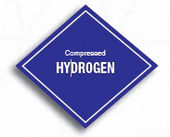
Compressed hydrogen storage mark
Hydrogen has a very low volumetric energy
density at ambient conditions, equal to about one-third that of methane. Even when the fuel is stored as
liquid hydrogen in a
cryogenic tank or in a
compressed hydrogen storage tank, the volumetric energy density (megajoules per liter) is small relative to that of gasoline.
[37] Hydrogen has a three times higher
specific energy by
mass compared to gasoline (143 MJ/kg versus 46.9 MJ/kg). Some research has been done into using special
crystalline materials to store hydrogen at greater densities and at lower pressures. A recent study by Dutch researcher Robin Gremaud has shown that metal hydride hydrogen tanks are actually 40 to 60-percent lighter than an equivalent energy battery pack on an electric vehicle permitting greater range for H2 cars.
[58] In 2011, scientists at
Los Alamos National Laboratory and
University of Alabama, working with the
U.S. Department of Energy, found a new single-stage method for recharging ammonia borane, a hydrogen storage compound.
[59][60]
Infrastructure[edit]
Hydrogen use would require the alteration of industry and transport on a scale never seen before in history. For example, according to GM, 70% of the U.S. population lives near a hydrogen-generating facility but has little access to hydrogen, despite its wide availability for commercial use.
[61] The distribution of hydrogen fuel for vehicles throughout the U.S. would require new hydrogen stations that would cost, by some estimates approximately 20 billion dollars
[62]and 4.6 billion in the EU.
[63] Other estimates place the cost as high as half trillion dollars in the United States alone.
[64]
Codes and standards[edit]
Criticism[edit]
Critics claim the time frame for overcoming the technical and economic challenges to implementing wide-scale use of hydrogen cars is likely to last for at least several decades, and hydrogen vehicles may never become broadly available.
[47][70] They claim that the focus on the use of the hydrogen car is a dangerous detour from more readily available solutions to reducing the use of fossil fuels in vehicles.
[71] In May 2008,
Wired News reported that "experts say it will be 40 years or more before hydrogen has any meaningful impact on gasoline consumption or global warming, and we can't afford to wait that long. In the meantime, fuel cells are diverting resources from more immediate solutions."
[72]
K. G. Duleep speculates that "a strong case exists for continuing fuel-efficiency improvements from conventional technology at relatively low cost."
[73] Critiques of hydrogen vehicles are presented in the 2006 documentary,
Who Killed the Electric Car?. According to former
U.S. Department of Energy official
Joseph Romm, "A hydrogen car is one of the least efficient, most expensive ways to reduce greenhouse gases." Asked when hydrogen cars will be broadly available, Romm replied: "Not in our lifetime, and very possibly never."
[73] The
Los Angeles Times wrote, in February 2009, "Hydrogen fuel-cell technology won't work in cars. ... Any way you look at it, hydrogen is a lousy way to move cars."
[74]
The Wall Street Journal reported in 2008 that "Top executives from General Motors Corp. and Toyota Motor Corp. Tuesday expressed doubts about the viability of hydrogen fuel cells for mass-market production in the near term and suggested their companies are now betting that electric cars will prove to be a better way to reduce fuel consumption and cut tailpipe emissions on a large scale."
[75] The Economist magazine, in September 2008, quoted
Robert Zubrin, the author of
Energy Victory, as saying: "Hydrogen is 'just about the worst possible vehicle fuel'".
[76] The magazine noted the withdrawal of California from earlier goals: "In March [2008] the
California Air Resources Board, an agency of California's state government and a bellwether for state governments across America, changed its requirement for the number of
zero-emission vehicles (ZEVs) to be built and sold in California between 2012 and 2014. The revised mandate allows manufacturers to comply with the rules by building more battery-electric cars instead of fuel-cell vehicles."
[76] The magazine also noted that most hydrogen is produced through steam reformation, which creates at least as much emission of carbon per mile as some of today's gasoline cars. On the other hand, if the hydrogen could be produced using renewable energy, "it would surely be easier simply to use this energy to charge the batteries of all-electric or plug-in hybrid vehicles."
[76]
The Washington Post asked in November 2009, "But why would you want to store energy in the form of hydrogen and then use that hydrogen to produce electricity for a motor, when electrical energy is already waiting to be sucked out of sockets all over America and stored in auto batteries"? The paper concluded that commercializing hydrogen cars is "stupendously difficult and probably pointless. That's why, for the foreseeable future, the hydrogen car will remain a tailpipe dream".
[51] A December 2009 study at
UC Davis, published in the
Journal of Power Sources, found that, over their lifetimes, hydrogen vehicles will emit more carbon than gasoline vehicles.
[77] In July 2011, the Chairman and CEO of
General Motors,
Daniel Akerson, stated that while the cost of hydrogen fuel cell cars is decreasing: "The car is still too expensive and probably won't be practical until the 2020-plus period, I don't know."
[70][78] GM's
Vauxhall Motors spokesman Bill Parfitt expects the
HydroGen4 in 2016.
[79][80]
The
Obama Administration sought to reduce funding for the development of fuel cell vehicles, concluding that other vehicle technologies will lead to quicker reduction in emissions in a shorter time.
[81] Steven Chu, the
US Secretary of Energy, stated in 2009 that hydrogen vehicles "will not be practical over the next 10 to 20 years".
[35][82] In 2012, however, Chu stated that he sees fuel cell cars as more economically feasible as natural gas prices have fallen and hydrogen reforming technologies have improved.
[83][84]
Comparison with other types of alternative fuel vehicle[edit]
Hydrogen vehicles are one of a number of proposed alternatives to the modern
fossil fuel powered vehicle infrastructure.
[37]
Plug-in hybrids[edit]
Plug-in hybrid electric vehicles, or PHEVs, are
hybrid vehicles that can be plugged into the electric grid and contain an electric motor and also an
ICE or other engine. The
Chevrolet Volt, the first commercially-manufactured PHEV, became commercially available in some U.S. states in 2010 and in more locations in 2011. The PHEV concept augments standard
hybrid electric vehicles with the ability to recharge their batteries from an external source while parked, enabling increased use of the vehicle's electric motors while reducing their reliance on internal combustion engines. The infrastructure required to charge PHEVs is already in place,
[85] and transmission of power from grid to car is about 93% efficient.
[86] This, however, is not the only energy loss in transferring power from grid to wheels. AC/DC conversion must take place from the grids AC supply to the PHEV's DC. This is roughly 98% efficient.
[87] The battery then must be charged. As of 2007, the
Lithium iron phosphate battery was between 80-90% efficient in charging/discharging.
[88] The battery needs to be cooled; the GM Volt's battery has 4 coolers and two radiators.
[89] As of 2009, "the total well-to-wheels efficiency with which a hydrogen fuel cell vehicle might utilize renewable electricity is roughly 20% (although that number could rise to 25% or a little higher with the kind of multiple technology breakthroughs required to enable a hydrogen economy). The well-to-wheels efficiency of charging an onboard battery and then discharging it to run an electric motor in a PHEV or EV, however, is 80% (and could be higher in the future)—four times more efficient than current hydrogen fuel cell vehicle pathways."
[50] A 2006 article in
Scientific American argued that PHEVs, rather than hydrogen vehicles, would become standard in the automobile industry.
[90][91] A December 2009 study at UC Davis found that, over their lifetimes, PHEVs will emit less carbon than current vehicles, while hydrogen cars will emit more carbon than gasoline vehicles.
[77]
Natural gas[edit]
ICE-based
CNG or
LNG vehicles (
Natural gas vehicles or NGVs) use
Natural gas or
Biogas as a fuel source. Natural gas has a higher
energy density than hydrogen gas. Natural gas powered vehicles have a lower carbon dioxide footprint than ICE vehicles. When using Biogas, NGVs become
carbon neutral vehicles that run on animal waste.
[92] CNG vehicles have been available for several years, and there is sufficient infrastructure to provide both commercial and home refueling stations. In 2008, the
ACEEE rated the
Honda Civic GX, which uses compressed natural gas, as the greenest vehicle available.
[93][94][95] Worldwide, there were 14.8 million natural gas vehicles by the end of 2011.
[96]
Battery electric vehicles[edit]
A 2008
Technology Review article stated, "Electric cars—and plug-in hybrid cars—have an enormous advantage over hydrogen fuel-cell vehicles in utilizing low-carbon electricity. That is because of the inherent inefficiency of the entire hydrogen fueling process, from generating the hydrogen with that electricity to transporting this diffuse gas long distances, getting the hydrogen in the car, and then running it through a fuel cell—all for the purpose of converting the hydrogen back into electricity to drive the same exact electric motor you'll find in an electric car."
[97]Thermodynamically, each additional step in the conversion process decreases the overall efficiency of the process.
[98][99] Many
BEV designs offer limited driving range. For example, The
Nissan Leaf, the first commercially-manufactured BEV, which became available in some U.S. states beginning in 2010, has a maximum range of 100 miles.
Mini E users have reported a range of between 100–120 miles (160–190 km).
[100] However, most commutes are 30–40 miles (48–64 km) miles per day round trip.
Ed Begley, Jr., a battery electric car advocate, noted wryly, "The detractors of electric vehicles are right. Given their limited range, they can only meet the needs of 90 percent of the population."
[50]


